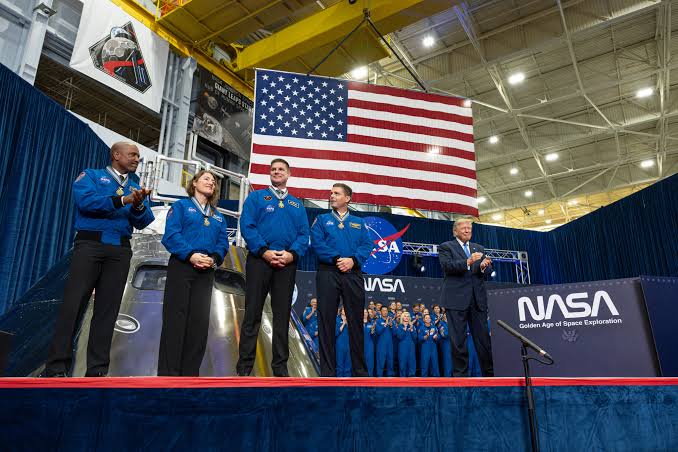
On a Friday at NASA’s Johnson Space Center in Houston, President Donald J. Trump awarded the Congressional Space Medal of Honor to the four astronauts of the Artemis II mission the first crewed lunar flyby since 1972. The ceremony recognized not just a successful mission but a pivotal step in humanity’s return to deep space.
The medal, the highest civilian space award in the U.S., is given by the President on behalf of Congress for exceptionally meritorious efforts in spaceflight. This year’s recipients Reid Wiseman, Victor Glover, Christina Koch, and Jeremy Hansen earned it by piloting the Orion spacecraft around the Moon and back, testing systems that will carry the next astronauts to land on the lunar surface.
A Historic Mission, A Historic Honor
Artemis II launched in November 2024, carrying four astronauts farther from Earth than any humans in over half a century. Over roughly 10 days, the crew orbited the Moon, tested Orion’s life support, navigation, and manual handling, and returned safely in December. It was the first crewed flight of NASA’s powerful Space Launch System (SLS) rocket and the Orion capsule.
The mission broke new ground: Christina Koch became the first woman to travel to lunar vicinity, and Jeremy Hansen became the first Canadian. Victor Glover was the first Black astronaut to make the journey. Their safe return paved the way for Artemis III, which aims to land astronauts near the Moon’s south pole by mid-2027.
What Is the Congressional Space Medal of Honor?
Congress established this medal in 1969, shortly after the Apollo 11 moon landing, to recognize astronauts who go above and beyond in service to the nation and humanity. The President awards it on behalf of Congress. Past recipients include Neil Armstrong, Buzz Aldrin, John Glenn, Sally Ride, and the crews of Apollo 13 and the Space Shuttle Columbia.
This year’s award is notable for two reasons. It is the first time the medal has been given to a non-U.S. citizen—Jeremy Hansen of the Canadian Space Agency—reflecting the growing international collaboration in space exploration. And it is the first time it has been awarded for a mission that didn’t land on the Moon or fly to orbit, but instead flew around it.
The Crew: Who They Are and What They Did
Reid Wiseman – Commander
A U.S. Navy captain and former chief of the NASA Astronaut Office, Wiseman previously spent 165 days on the International Space Station in 2014. As Artemis II commander, he was responsible for the overall mission and the crew’s safety during the lunar flyby.
Victor Glover – Pilot
Glover, also a U.S. Navy captain, piloted SpaceX’s Crew-1 mission in 2020-2021, becoming the first Black astronaut to complete a long-duration ISS mission. On Artemis II, he served as pilot, manually flying the Orion spacecraft during key maneuvers—a critical test of human control in deep space.
Christina Koch – Mission Specialist
An electrical engineer, Koch holds the record for the longest single spaceflight by a woman at 328 days. She also participated in the first all-female spacewalk in 2019. On Artemis II, she monitored spacecraft systems and helped test radiation shielding and life support—data essential for future Mars missions.
Jeremy Hansen – Mission Specialist
A retired colonel in the Canadian Armed Forces, Hansen was selected as a CSA astronaut in 2009. He is the first Canadian to be assigned to a lunar mission. His role on Artemis II included testing Orion’s navigation and communication systems, and his participation highlights the Artemis Accords, an international agreement for peaceful space exploration signed by over 40 nations.
Why This Award Matters
The Congressional Space Medal of Honor is not given lightly. It recognizes contributions that “contribute to the welfare of the nation and humankind.” The Artemis II crew’s work fits that description: they validated the Orion spacecraft for human deep-space travel, proving that the vehicle can safely carry astronauts to the Moon and back.
That validation is the cornerstone of NASA’s Artemis program, which aims to establish a sustainable human presence on the Moon and eventually send astronauts to Mars. Without the successful Artemis II mission, Artemis III’s landing attempt would be far riskier. The crew’s testing of manual control, life support, and radiation protection in the lunar environment provided the data engineers need to prepare for that next leap.
The ceremony also carries political weight. President Trump chose to honor the crew at Johnson Space Center in Texas, a state with significant NASA facilities and a growing commercial space industry. The award underscores the administration’s support for Artemis, even as debates continue over NASA’s budget and the program’s cost overruns. But the medal itself is meant to be nonpartisan—a recognition of American leadership in space and the international partnerships that make such missions possible.
A Personal Milestone for the Astronauts
For each of the four astronauts, the medal is the capstone of years of training and a testament to their individual journeys. Koch’s presence on the mission inspires women and girls to pursue STEM careers; Glover’s role as a Black pilot continues the diversification of NASA’s astronaut corps; Hansen’s award strengthens Canada’s role in human spaceflight. Together, they represent the best of what space exploration can achieve when nations and individuals work toward a common goal.
The Road Ahead
Artemis II was a stepping stone. The next mission, Artemis III, will attempt the first crewed lunar landing since Apollo 17 in 1972. The crew of Artemis II has shown that Orion is ready for that challenge. Their medal is not just a reward for past achievement but a promise of what lies ahead—a future where humans walk on the Moon again, and eventually, set foot on Mars.
The Congressional Space Medal of Honor awarded to the Artemis II crew is a well-deserved recognition of a mission that expanded human reach and set the stage for the next era of exploration. As the crew moves on to new roles, their achievement will inspire generations to look up and wonder what lies beyond.
Summary
- Artemis II was the first crewed lunar flyby since Apollo 17, lasting about 10 days in November-December 2024.
- The crew included Reid Wiseman, Victor Glover, Christina Koch, and Jeremy Hansen, each making history in space exploration.
- The Congressional Space Medal of Honor is the highest U.S. civilian space award, established in 1969.
- This was the first time the medal was awarded to a non-U.S. citizen, highlighting international collaboration.
- The mission validated Orion’s systems for human deep-space travel, paving the way for Artemis III’s lunar landing.
FAQ
Q: What is the Congressional Space Medal of Honor?
A: It is the highest civilian space award in the United States, established by Congress in 1969. The President awards it on behalf of Congress to astronauts who make exceptionally meritorious contributions to the nation’s welfare and humanity through spaceflight.
Q: Who received the medal this time?
A: The four Artemis II astronauts: NASA’s Reid Wiseman, Victor Glover, and Christina Koch, and CSA’s Jeremy Hansen. They were honored for their successful mission around the Moon.
Q: Why is this award historic?
A: It is the first time the medal has been given to a non-U.S. citizen (Jeremy Hansen) and the first time for a lunar flyby mission rather than a landing or orbital flight.
Q: What was the Artemis II mission?
A: Artemis II was the first crewed test of NASA’s Space Launch System and Orion spacecraft. The crew flew around the Moon and returned, testing life support, navigation, and manual handling systems needed for future lunar landings.
Q: What comes next for the Artemis program?
A: The next mission, Artemis III, aims to land astronauts near the Moon’s south pole, potentially by 2027. It will be the first crewed lunar landing since Apollo 17 in 1972.