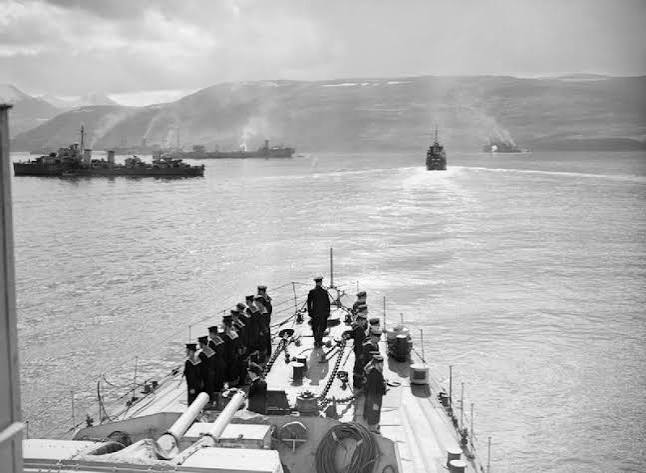
In the summer of 1941, as German forces surged into the Soviet Union, a new kind of naval operation was born. The Arctic convoys slow, vulnerable columns of merchant ships began threading their way through the icy waters north of Norway, carrying tanks, aircraft, and fuel to the beleaguered Red Army. The route was the shortest sea link between the Western Allies and the Soviet Union, but it was also the most lethal. Over the next four years, these convoys would become a crucible of courage and catastrophe, claiming the lives of thousands of seamen and testing the limits of Allied endurance.
This is the story of how a few hundred merchant ships, escorted by the Royal Navy, braved polar darkness, German battleships, and relentless air attacks to keep the Soviet Union in the war and at what cost.
A Route Carved by War
The Arctic convoys began in August 1941, just two months after Germany invaded the Soviet Union. The first convoy, codenamed Dervish, sailed from Iceland to Arkhangelsk with a modest cargo of raw materials and aircraft. It was a test run, and it succeeded. But the stakes were immense. The Soviet Union was reeling from Operation Barbarossa, losing men and territory at a staggering rate. Stalin demanded supplies tanks, planes, guns, food and the Western Allies, still reeling from their own setbacks, had to find a way to deliver them.
The shortest sea route ran from Iceland, around the North Cape of Norway, and into the Barents Sea to the ports of Murmansk and Arkhangelsk. It was a passage of extraordinary danger. In winter, the polar night plunged the region into total darkness for months, with temperatures dropping to -40°F and storms that could capsize a ship. In summer, the midnight sun meant 24-hour daylight, offering German aircraft and U-boats no respite. Sea spray froze on decks and guns, and ice accretion could make a ship top-heavy and roll it over.
Yet the route was also a strategic necessity. The alternative the Persian Corridor or the Pacific route was longer and less direct, and the Soviet Union was in desperate need. So the convoys sailed, and the losses began to mount.
The Ordeal of PQ-17
The most infamous convoy of the war was PQ-17, which sailed from Iceland in late June 1942. It consisted of 35 merchant ships, escorted by a close escort of destroyers and corvettes, with a distant covering force of cruisers and battleships to guard against German surface raiders. Among the German threats was the battleship Tirpitz, a massive and feared vessel that lurked in Norwegian fjords.
On July 4, 1942, the Admiralty received intelligence that Tirpitz had sortied. Fearing that the convoy would be annihilated, First Sea Lord Dudley Pound made a controversial decision: he ordered the convoy to scatter, dispersing the merchant ships so that the covering force could engage the German ships. But the intelligence was wrong—Tirpitz had not sailed, and the convoy was left without protection.
The result was a massacre. German U-boats and aircraft attacked the scattered ships, sinking 24 of 35 merchant vessels. More than 150 seamen died, and thousands of tons of tanks and aircraft went to the bottom of the Barents Sea. The decision to scatter remains one of the most debated command choices of the war, and it highlighted the brutal calculus of the Arctic convoys: sometimes, the risk of losing the cargo was deemed worse than the risk of losing the men.
Endurance and Valor: PQ-18 and the Battle of the Barents Sea
Despite the disaster of PQ-17, the convoys resumed. Convoy PQ-18, in September 1942, was the largest yet, with 40 merchant ships. It faced a determined German assault from aircraft and U-boats, losing 13 ships, but it delivered vital cargo to Arkhangelsk. The escorting aircraft carrier HMS Avenger provided air cover, a lesson learned from PQ-17’s losses.
The most dramatic surface engagement came in December 1942, when a German force led by the heavy cruiser Admiral Hipper and the pocket battleship Lützow attacked convoy JW-51B in the Barents Sea. The escort, commanded by Captain Robert Sherbrooke in the destroyer HMS Onslow, fought a brilliant defensive action. Despite being outgunned and outmatched, the destroyers laid smoke screens and launched torpedo attacks, forcing the German ships to withdraw. Rear Admiral Robert Burnett’s cruisers arrived to drive them off. The battle was a strategic humiliation for the Kriegsmarine—a convoy had been saved, and Hitler, furious, threatened to scrap the entire surface fleet.
The Toll and the Forgotten
The Arctic convoys continued until the end of the war, but they exacted a terrible price. Roughly 85 merchant ships and 16 Royal Navy warships were sunk, and over 3,000 British and Allied seamen lost their lives. The merchant crews—many of them civilian volunteers from Britain, the United States, Norway, and the Soviet Union—suffered the highest casualty rates of any Allied service branch. They endured freezing cold, constant danger, and the psychological strain of knowing that every voyage could be their last.
Yet their sacrifice was often overlooked. After the war, the Soviet Union became an adversary, and the Arctic convoys were relegated to a footnote in the larger narrative of the Second World War. Many veterans returned to civilian life with no recognition, suffering from frostbite, trauma, and the indifference of a world eager to move on.
A Legacy of Courage
The Arctic convoys delivered roughly 4 million tons of cargo to the Soviet Union, including about 5,000 tanks, 7,000 aircraft, and 14,000 vehicles. This material helped sustain the Red Army during the darkest days of the war, but the cost was immense. The convoys were a testament to the endurance of ordinary men in extraordinary circumstances—men who faced not only the enemy but also the brutal indifference of the Arctic itself.
Today, their story is remembered in museums and memorials, and in the words of veterans who finally received recognition in their later years. The Arctic convoys remain a stark reminder of the price of alliance and the courage of those who sailed into the frozen unknown.
The Arctic convoys were more than a supply route; they were a lifeline that helped turn the tide on the Eastern Front. They were also a human tragedy of staggering proportions, where ordinary sailors faced extraordinary perils. Their story is one of courage, sacrifice, and the enduring bond between allies—even as the cold war that followed threatened to erase it. The men who sailed those icy waters deserve to be remembered not just as statistics, but as heroes who braved the worst that war and nature could throw at them.
Summary
- The Arctic convoys (1941–1945) delivered ~4 million tons of supplies to the Soviet Union, including ~5,000 tanks and ~7,000 aircraft.
- The route was the most dangerous of the war, with polar night, midnight sun, and constant German attacks.
- Convoy PQ-17 lost 24 of 35 ships after an order to scatter based on false intelligence.
- The Battle of the Barents Sea (December 1942) saw a German surface force repelled, saving convoy JW-51B.
- Over 3,000 Allied seamen died, and many survivors faced post-war neglect.
FAQ
Q: How many ships were lost on the Arctic convoys?
A: Approximately 85 merchant ships and 16 Royal Navy warships were sunk during the Arctic convoys.
Q: What was the most infamous convoy?
A: Convoy PQ-17, which was ordered to scatter in July 1942 after a false fear of the German battleship Tirpitz, resulting in the loss of 24 of 35 merchant ships.
Q: Why were the convoys so dangerous?
A: The route passed within range of German air and naval forces in Norway, and the environment itself was lethal—polar darkness in winter, 24-hour daylight in summer, extreme cold, and ice accretion that could capsize ships.
Q: What role did the Soviet Union play in the convoys?
A: The Soviets provided local escort and port facilities, but did not commit major naval forces to protect the convoys at sea. Stalin repeatedly demanded faster deliveries, often downplaying the risks.
Q: What was the outcome of the Battle of the Barents Sea?
A: In December 1942, a German surface force attacked convoy JW-51B but was repelled by escorting destroyers, a strategic humiliation for the Kriegsmarine that led Hitler to threaten to scrap the surface fleet.