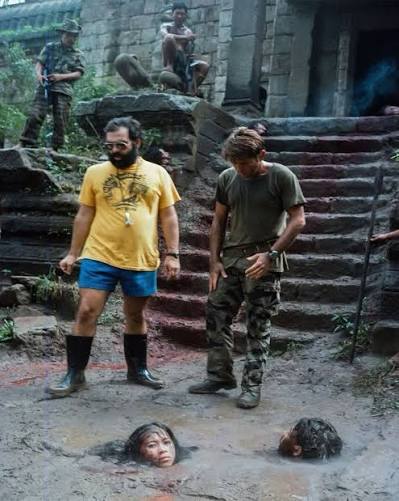
In May 1976, Typhoon Olga slammed into the Philippines, shredding the jungle sets of Francis Ford Coppola’s Vietnam War epic. Dozens of crew members were left sick with dysentery, helicopters were being recalled to fight a real insurgency, and the director was threatening to kill himself. That was just the first year. Over the next three, a heart attack would nearly kill the lead actor, a stolen workprint would test Coppola’s nerve, and the film would stagger to a Cannes premiere as an unfinished workprint. The result: a Palme d’Or, eight Oscar nominations, and one of cinema’s most legendary production nightmares.
A Budget That Melted in the Jungle
Coppola had conquered Hollywood with The Godfather and its sequel. For his next act, he wanted to turn Joseph Conrad’s Heart of Darkness into a hallucinatory journey up a Vietnamese river. He co-wrote the script with John Milius and Michael Herr, but the real story began when cameras rolled in March 1976. The initial budget was around $12 million. By the time the film limped into theaters in August 1979, the tab had ballooned past $30 million. Coppola, who had mortgaged his house to keep production alive, was betting everything on a film that seemed to be actively fighting him.
The Typhoon That Erased a War Zone
The Philippines stood in for Vietnam—jungle terrain, U.S. military hardware on loan, and a government willing to provide helicopters and troops. But the monsoon season brought Typhoon Olga (local name: Didang). The storm destroyed the main jungle sets, including the Do Lung Bridge and the Kurtz compound. Production shut down for weeks while crews rebuilt from scratch. Coppola’s wife, Eleanor, who was documenting the production, captured the director’s despair: he reportedly broke down, saying, “My film is ruined.”
A Heart Attack Caught on Camera
Martin Sheen, playing Captain Willard, was not the first choice for the role. Harvey Keitel had been fired early on, and Sheen stepped in. But in March 1977, while filming the opening hotel room scene, Sheen suffered a near-fatal heart attack. He was given last rites by a priest. The footage of his breakdown—real, raw, and terrifying—was so compelling that Coppola used it in the final film. Sheen survived, returned to set weeks later, and the film kept going.
Brando, Hopper, and the Helicopters
Marlon Brando arrived overweight and unprepared. Coppola had to shoot him in shadow to conceal his size. Dennis Hopper was, by all accounts, a whirlwind of erratic energy. The Philippine government’s helicopters were sometimes recalled for actual military missions against insurgents, leaving the crew grounded. Dysentery swept through the cast and crew. Coppola, pushed to the brink, reportedly threatened suicide on set—an episode captured in the making-of documentary Hearts of Darkness.
The Stolen Print
At some point during production or post-production, a copy of the film—a workprint, at least—was stolen from a screening room. Accounts differ: some place it in the Philippines, others in Los Angeles. The thieves demanded ransom. Coppola refused to pay. The copy was eventually recovered or destroyed, but the incident added another layer of paranoia to an already fraught production. The exact details remain murky, but the story has become part of the film’s mythology.
The Never-Ending Ending
Coppola had no clear ending for the film. He shot multiple versions, including one with a giant statue and one with the crew returning to the boat. In the editing room, he and his team pieced together the final “Colonel Kurtz dies” sequence from hours of footage, largely improvising the structure. The score, a mix of Carmine Coppola’s music and The Doors’ “The End,” was assembled over many months. The film screened at Cannes in 1979 as a workprint—still unfinished—and shared the Palme d’Or with The Tin Drum. It went on to earn eight Academy Award nominations and won two, for Cinematography and Sound.
The Chaos That Made a Masterpiece
Could the film have been made without the chaos? Perhaps, but the chaos is part of its DNA. The real exhaustion, the genuine danger, and the improvisation seeped into the performances and the atmosphere. Eleanor Coppola’s behind-the-scenes footage and audio diaries, later compiled into Hearts of Darkness: A Filmmaker’s Apocalypse (1991), turned the production itself into a gripping documentary. The film endures as a landmark of New Hollywood cinema, but its production story has become as legendary as the movie itself. Typhoons, heart attacks, stolen prints, and a director on the edge—Apocalypse Now is a testament to what can happen when art and disaster collide.
The production of Apocalypse Now was a four-year nightmare that nearly destroyed its creator. Yet the film that emerged from the wreckage is a haunting, visceral masterpiece. It stands as proof that sometimes, the most chaotic paths lead to the most enduring art—and that the story behind the film can be as unforgettable as the film itself.
Summary
- Apocalypse Now took over three years to make and cost over $30 million, far exceeding its initial $12 million budget.
- A typhoon destroyed the main sets in the Philippines, halting production for weeks.
- Martin Sheen suffered a near-fatal heart attack during filming; Coppola used the real footage in the movie.
- A workprint of the film was stolen and held for ransom; Coppola refused to pay.
- Despite the chaos, the film won the Palme d’Or and two Oscars, and is now considered a classic.
FAQ
Q: Was Apocalypse Now based on a book?
A: Yes, it was loosely adapted from Joseph Conrad’s novella Heart of Darkness, transposed from the Congo to the Vietnam War.
Q: How long did principal photography last?
A: Principal photography began in March 1976 and lasted over a year, but the film wasn’t released until August 1979 due to lengthy post-production and re-editing.
Q: Did the typhoon really destroy the sets?
A: Yes, Typhoon Olga (known locally as Didang) struck the Philippines in May 1976 and destroyed the main jungle sets, including the Kurtz compound and the Do Lung Bridge.
Q: Is the story about Martin Sheen’s heart attack true?
A: Yes, Sheen suffered a near-fatal heart attack in March 1977. He was given last rites but recovered and returned to filming. Some of the footage from his breakdown was used in the opening scene.
Q: Was the stolen print ever recovered?
A: Accounts vary, but most say the copy was eventually recovered or destroyed. Coppola refused to pay the ransom, and the incident remains a murky part of the film’s legend.