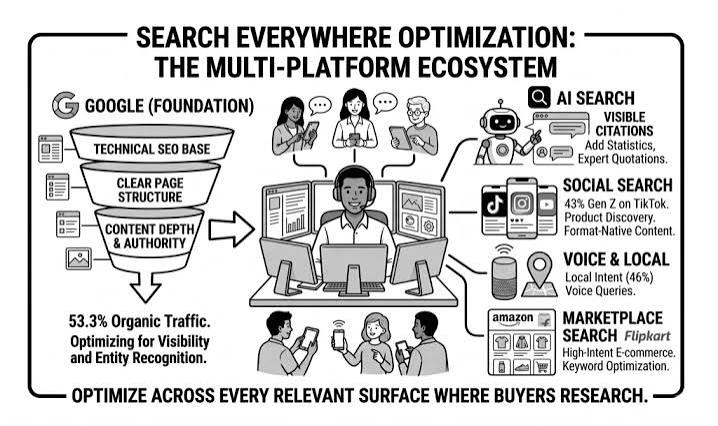
When you need a quick answer, where do you turn? For many, it’s still Google. But for a growing number of people, especially under 30, the search starts elsewhere: a TikTok hashtag, an Amazon product page, a YouTube tutorial, or a typed question into ChatGPT. Search has fragmented, and so must your brand’s visibility strategy.
Search Everywhere Optimization (SEO) is the practice of making your brand discoverable across every platform where people search not just traditional search engines. It means optimizing your content for TikTok’s algorithm, your product listings for Amazon’s search, and your structured data for AI chatbots. This guide breaks down what SEO is, why it matters now, and how to execute it without spreading yourself too thin.
Why Search Everywhere, Not Just Google?
For two decades, Google was the front door to the internet. But in 2024, that front door has multiple entrances. Consider these numbers: 40% of Gen Z prefer TikTok for discovery over Google. Over half of product searches on Amazon start there, not on a search engine. And AI chatbots like ChatGPT and Perplexity are becoming the go-to for direct answers, often without any click to a website.
The result? A potential customer might see your brand on Instagram, verify it on Reddit, and purchase on Amazon never once touching Google. If you’re only optimizing for Google, you’re invisible to that entire journey.
Core Components of Search Everywhere Optimization
Platform-Specific Content Optimization
Each platform has its own search algorithm and user expectations. What works on Google won’t necessarily work on TikTok or Amazon.
- TikTok: SEO relies on captions, hashtags, and engagement signals. Use relevant keywords in your video captions and on-screen text. Research trending sounds and topics within your niche.
- Amazon: Product titles, bullet points, and backend keywords are crucial. Include the exact terms shoppers use, and encourage reviews they’re a key ranking factor.
- YouTube: Optimize video titles, descriptions, and tags. Pay attention to watch time and audience retention, as they signal quality to the algorithm.
- Pinterest: Focus on high-quality visuals and keyword-rich pin descriptions. Pinterest acts as a visual search engine for ideas and products.
Unified Brand Consistency
While each platform requires tailored content, your brand identity should be consistent. Use the same name, logo, and core messaging across all channels. This builds recognition and trust, making it easier for users to find and remember you.
Schema Markup and Structured Data
Schema markup is code you add to your website to help search engines and AI understand your content. For example, marking up your business hours, reviews, and product details can make you eligible for rich results and better AI comprehension. As AI chatbots pull from web content, structured data helps them accurately cite your brand.
Social Listening and Trend Monitoring
Pay attention to what your audience is searching for on each platform. Use social listening tools to track mentions, trending topics, and questions. This informs your content strategy, allowing you to create material that matches platform-native search behavior.
Measurement Across Channels
Track your share of voice, impressions, and direct traffic from each platform. Tools like Semrush and Ahrefs are expanding to monitor cross-platform visibility. Set up UTM parameters to see which platforms drive the most valuable traffic.
The Skeptic’s View: Is This Just Old Wine in New Bottles?
Some traditional SEO purists argue that ‘Search Everywhere’ is just a rebranding of existing practices—social media marketing, content marketing, and marketplace optimization. They point out that Google still drives the majority of web traffic, and its AI Overviews still pull from web content, so traditional SEO fundamentals remain crucial.
There’s merit to this. You shouldn’t abandon your Google strategy. But the shift is real: user behavior has changed. If you ignore TikTok, Amazon, and AI chatbots, you’re missing segments of your audience. The key is to prioritize platforms where your customers actually search, not to be everywhere at once.
How to Get Started with Search Everywhere Optimization
1. Audit Your Current Presence
List every platform where your brand exists or should exist: Google, Bing, TikTok, Instagram, YouTube, Pinterest, Amazon, Etsy, and AI chatbots. For each, assess your current visibility. Are you optimized? Do you have complete profiles? Are you using platform-specific features?
2. Identify Your Audience’s Search Habits
Where does your target audience search? If you sell beauty products, TikTok and Instagram are likely high-priority. If you sell software, Google and YouTube may dominate. Use analytics, surveys, and social listening to find out.
3. Optimize for Each Platform
Create a checklist for each platform:
- Search Engines: Continue with traditional SEO—keywords, backlinks, technical health.
- Social Media: Use keywords in bios, captions, and hashtags. Engage with comments to boost signals.
- Marketplaces: Optimize titles, bullets, and images. Encourage reviews.
- AI Chatbots: Ensure your website has clear, structured data. Get cited in authoritative sources.
4. Create Platform-Native Content
Don’t just repurpose the same content everywhere. A TikTok video should be short, trending, and engaging. A YouTube tutorial should be longer and educational. An Amazon listing should be concise and benefit-focused. Tailor your content to each platform’s culture.
5. Monitor and Adjust
Regularly review your performance on each platform. Use built-in analytics and third-party tools. Adjust your strategy based on what’s working. Remember, SEO is an ongoing process.
The Role of AI Chatbots in Search
AI chatbots like ChatGPT and Perplexity are changing how people get answers. Instead of scrolling through links, users ask a question and get a synthesized response. This means your content needs to be structured so that AI can easily understand and cite it.
- Use clear headings and concise paragraphs on your website.
- Implement schema markup for products, articles, and FAQs.
- Ensure your content is factually accurate and up-to-date.
Some AI companies are even partnering with publishers to license content. This could become a new avenue for brand visibility.
Conclusion
Search is no longer a single gateway but a network of discovery points. Search Everywhere Optimization acknowledges this reality and adapts your strategy accordingly. You don’t have to be everywhere, but you should be where your customers search. Start by auditing your presence, understanding your audience, and optimizing platform by platform. The effort will pay off in visibility, trust, and sales.
The days of a single search engine dominating discovery are over. By adopting Search Everywhere Optimization, you ensure your brand is present wherever your audience is looking—whether that’s on Google, TikTok, Amazon, or through an AI assistant. Begin small, measure results, and expand your presence where it matters most.
Summary
- Search Everywhere Optimization (SEO) means optimizing for all search-enabled platforms, not just Google.
- User behavior has fragmented: Gen Z uses TikTok for discovery, many start product searches on Amazon, and AI chatbots provide direct answers.
- Core components include platform-specific content, brand consistency, schema markup, social listening, and cross-channel measurement.
- Traditional SEO still matters, but integrating other platforms captures a broader audience.
- Start by auditing your presence, understanding your audience’s habits, and optimizing each platform accordingly.
FAQ
Q: What is Search Everywhere Optimization?
A: It’s the practice of optimizing your brand’s visibility across all platforms where people search, including social media, marketplaces, video platforms, and AI chatbots, in addition to traditional search engines like Google.
Q: Why is SEO important now?
A: Because user behavior has changed. Many people now search on TikTok, Amazon, and AI chatbots instead of Google, so to be found, you need to be visible on those platforms too.
Q: How is SEO different from traditional SEO?
A: Traditional SEO focuses on Google rankings through keywords and backlinks. SEO expands this to include platform-native algorithms, visual and voice search, and conversational AI, requiring a multi-surface approach.
Q: Do I need to be on every platform?
A: No. Focus on platforms where your target audience actually searches. Start with a few high-priority ones and expand based on data.
Q: How do I optimize for AI chatbots like ChatGPT?
A: Ensure your website has structured data (schema markup), clear headings, and factual content. Getting cited in reputable sources also increases your chances of being referenced by AI.