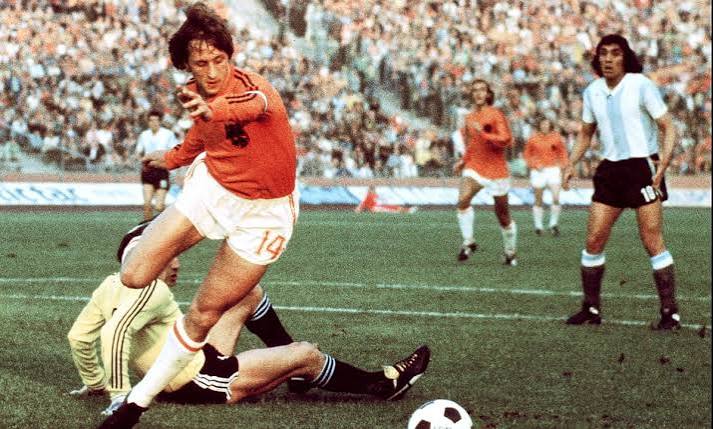
On June 7, 1974, the Netherlands kicked off the World Cup final against West Germany in Munich. Before the Germans had even touched the ball, Johan Cruyff had been fouled in the box and Johan Neeskens had converted the resulting penalty. The Dutch were 1-0 up after 120 seconds, having completed a sequence of 15 passes that left the tournament hosts chasing shadows. It was the purest expression of Total Football: a system where positions were fluid, space was paramount, and the team moved as a single, intelligent organism. Though the Dutch would lose that match 2-1, the ideas they unleashed in that tournament—and at Ajax a few years earlier—didn’t just win trophies. They rewired the tactical DNA of the sport.
Total Football wasn’t merely about versatility or players swapping positions. It was a holistic philosophy that treated the pitch as a geometric puzzle. Developed by Rinus Michels at Ajax in the late 1960s and perfected by Johan Cruyff on the field, the system demanded that every outfield player understand every role. Full-backs became wingers, forwards dropped into midfield, and the team’s shape stayed constant even as individuals rotated through it. This wasn’t chaos; it was choreographed disorder that overwhelmed opponents who were used to static formations. The approach carried Ajax to three consecutive European Cups (1971–1973) and the Netherlands to the 1974 World Cup final, where they became known as the ‘Clockwork Orange’ for their mesmerizing, mechanical precision.
But the revolution didn’t stop in the 1970s. Cruyff carried the philosophy to Barcelona as a coach in the late 1980s, where he seeded a style that would bloom under Pep Guardiola decades later. Today, the positional play of Manchester City, the pressing of Jürgen Klopp’s Liverpool, and the very idea of the ‘false 9’ all trace their lineage back to that Dutch experiment. This article breaks down how Total Football worked on the pitch, why it emerged in the Netherlands of all places, and how it became the most influential tactical movement in soccer history.
The Tactical Blueprint: How Total Football Actually Worked
At its core, Total Football was a response to a simple question: how can a team dominate both defense and attack simultaneously? The answer, as Michels and Cruyff conceived it, was to make the team shape fluid while the players’ movement remained organized. The system relied on several key principles that were radical for their time.
First, the high defensive line. Ajax and the Dutch national team pushed their back four up to the halfway line, compressing the pitch and forcing opponents into a narrow space. This made it nearly impossible for opponents to build from the back without being swarmed by pressing forwards. The offside trap was a deliberate weapon, not a risk—defenders stepped up in unison, and they practiced it relentlessly.
Second, universal player roles. In traditional football, a left-back stayed on the left, a center-forward stayed central. In Total Football, when a full-back like Ruud Krol pushed forward, a midfielder like Arie Haan would drop back to cover. When Cruyff dropped deep from his striker position to collect the ball, a winger like Johnny Rep would cut inside to occupy the central space. The pitch was divided into zones, not positions. Every player had to be technically proficient enough to pass, dribble, and shoot, and tactically intelligent enough to read the game and swap roles seamlessly.
Third, pressing and counter-pressing. Total Football wasn’t just about what you did with the ball; it was about what you did without it. The Dutch were among the first teams to implement coordinated pressing, where the nearest player would aggressively challenge the ball while teammates cut off passing lanes. If they lost possession, they would try to win it back within seconds—a concept now known as ‘counter-pressing’ or ‘gegenpressing.’ This was exhausting, so the team used possession itself as a defensive tool, keeping the ball for long stretches to control the tempo.
Finally, the ‘third man’ concept and spatial awareness. Cruyff preached that play should move to where the space was, not where the ball was. Players were encouraged to make runs that dragged defenders out of position, creating gaps for teammates to exploit. Quick one-touch passing triangles were the currency of this system. The famous ‘Cruyff Turn’—a feint and 180-degree spin that left defenders flat-footed—was a microcosm of this philosophy: it created space out of nothing.
The Architects: Michels, Cruyff, and the Ajax Machine
The system didn’t emerge from a vacuum. It was built on the foundations of Ajax’s youth academy, which had long emphasized technical skill and positional intelligence. Rinus Michels, a former Ajax player, returned as coach in 1965 with a ruthless vision. He was nicknamed ‘The General’ for his authoritarian methods, but his tactical innovations were revolutionary. He demanded fitness, discipline, and tactical flexibility—all qualities that Ajax’s homegrown players were uniquely suited to.
Johan Cruyff was the on-pitch embodiment of the philosophy. His football intelligence was so advanced that he could see patterns and spaces seconds before anyone else. He was also a vocal leader, constantly directing teammates, telling them where to run and pass. In his memoir, he famously said: ‘Playing football is very simple, but playing simple football is the hardest thing there is.’ His ability to execute the simplest action at precisely the right moment was what made him three times Ballon d’Or winner.
Ajax’s rise was swift. After losing the 1969 European Cup final to AC Milan, they won the competition three years running: 1971 against Panathinaikos, 1972 against Inter Milan, and 1973 against Juventus. The 1972 final was particularly symbolic—they dismantled Inter, the masters of catenaccio, the hyper-defensive Italian system. Total Football had conquered the most pragmatic defense in the world.
The 1974 World Cup: The Clockwork Orange’s Near-Perfect Campaign
The 1974 World Cup in West Germany was the stage where Total Football captured the world’s imagination. The Dutch team, built on a core of Ajax players—seven of the starting XI in the final had Ajax connections—swept through the tournament. They won all three group games and their second-round group, scoring 14 goals in just five matches. Their football was breathtaking, a blur of orange shirts moving in sync, opponents chasing shadows.
The semifinal against Brazil was a masterclass. The Dutch came from behind to win 2-0, with Cruyff scoring a stunning goal that showcased his athleticism and technique. The final against West Germany was politically charged—held in Munich, just 12 years after the war, with lingering wartime tensions. The Dutch took the lead from the penalty spot before Germany had even touched the ball, but they couldn’t hold on. Franz Beckenbauer’s team, themselves a tactical powerhouse, came back to win 2-1. It was a national trauma for the Dutch, who still refer to it as ‘the Miracle of Munich’—but from Germany’s perspective.
Despite the loss, the impact was lasting. The Dutch had shown that football could be played a different way—attacking, creative, and intelligent. The tournament was a turning point in tactical history, and the Dutch team’s style became a template for generations to come.
Cruyff’s Barcelona Legacy: From Dream Team to La Masia
After his playing career, Cruyff became the most influential evangelist of Total Football. As coach of Barcelona from 1988 to 1996, he implemented the principles he had learned from Michels, adapting them to his own vision. He built the ‘Dream Team’ that won four consecutive La Liga titles from 1991 to 1994 and the 1992 European Cup—the club’s first. More importantly, he established a style of play that became Barcelona’s identity.
Cruyff’s greatest long-term contribution was his influence on La Masia, the club’s youth academy. He insisted that all youth teams play the same possession-based, positional system as the first team. This philosophy created a conveyor belt of technically excellent, tactically versatile players, including Pep Guardiola, who played under Cruyff and later coached Barcelona to even greater heights.
Guardiola’s Barcelona (2008–2012) is widely considered one of the greatest teams ever, winning three La Liga titles and two Champions League trophies with a style that was a direct descendant of Total Football. The tiki-taka possession game, the pressing, the fluid movement of players like Lionel Messi in the ‘false 9’ role—all of it owes a debt to Cruyff’s teachings. Guardiola has since taken that philosophy to Bayern Munich and Manchester City, spreading it across Europe.
The Cultural Roots: Why the Netherlands?
Why did such a revolutionary tactical system emerge from a small country of about 13 million people? The answer lies in Dutch culture. The Netherlands has a long tradition of attacking, technical football, but also a more profound cultural inclination towards egalitarianism and consensus. Total Football reflected this: every player was equal, everyone contributed to attack and defense, and there was no room for prima donnas.
The 1974 squad also embodied the countercultural spirit of the 1970s. They were known for their collective decision-making, even disputing bonuses and commercial rights as a group. This off-pitch solidarity mirrored their on-pitch unity. The team’s orange kits, a nod to the Dutch royal family, became iconic.
Critics sometimes note that Total Football was a product of its time—that it relied on a unique generation of players and couldn’t be replicated. Indeed, the Netherlands under Michels in 1988 won the European Championship with a more pragmatic version of the philosophy, featuring players like Ruud Gullit and Marco van Basten. But the core principles—fluidity, pressing, positional interchange—have proven timeless, adapted by every top team in the modern era.
Conclusion: The Enduring DNA
Total Football didn’t just change how teams played; it changed how they thought about the game. It proved that tactical intelligence and collective movement could overcome physical and technical superiority. From Ajax’s European treble to the Dutch near-miss in 1974, and from Cruyff’s Dream Team to Guardiola’s modern powerhouses, the DNA of that revolution runs through soccer’s evolution. Today, when you see a full-back bombing forward and a midfielder covering the space behind, or a striker dropping deep to orchestrate play, you’re watching the ghost of Michels and Cruyff. The system may have been born in the 1960s, but its influence is eternal.
Total Football was more than a tactical system—it was a statement that football could be played beautifully and intelligently, with every player as an equal protagonist. The Dutch revolution of the 1970s didn’t achieve ultimate glory on the World Cup stage, but it won something more enduring: a permanent place in the sport’s imagination. As long as the ball is passed, space is probed, and teams press in unison, the legacy of Ajax and Johan Cruyff will live on. For every coach who preaches positional play and every team that dares to rotate, the ghost of ‘Clockwork Orange’ still guides the way.
Summary
- Total Football was a fluid tactical system developed by Rinus Michels at Ajax (1965–1971) and the Dutch national team (1974), where outfield players constantly interchanged positions while the team shape remained constant.
- Key principles included a high defensive line, offside trap, coordinated pressing, and the ‘third man’ concept to create and exploit space.
- Ajax won three consecutive European Cups (1971–1973) under Michels, with Johan Cruyff as the on-pitch orchestrator.
- The 1974 World Cup final saw the Netherlands lose 2–1 to West Germany despite taking an early lead, but their ‘Clockwork Orange’ style made them the tournament’s sensation.
- Cruyff’s Barcelona legacy (1988–1996) spread Total Football principles, influencing Pep Guardiola and modern possession-based, pressing football.
FAQ
Q: What exactly is Total Football?nA: Total Football is a tactical system where outfield players are versatile and interchange positions fluidly. The team shape remains consistent, but individual players rotate through roles, allowing full-backs to attack, forwards to drop deep, and midfielders to cover defense.nnQ: Who invented Total Football?nA: Rinus Michels, the coach at Ajax and the Dutch national team, is credited with developing and implementing the system. Johan Cruyff was its most famous player and later its main evangelist as a coach.nnQ: Why didn’t the Netherlands win the 1974 World Cup?nA: The Netherlands lost 2–1 to West Germany in the final in Munich. Despite taking an early lead, they were undone by a resilient German team. The loss was a national trauma, but the Dutch team’s style left a lasting impact on football.nnQ: How did Total Football influence modern soccer?nA: Total Football laid the groundwork for modern pressing, positional play, and fluid attacking systems. Coaches like Pep Guardiola have adapted its principles, and it directly influenced Barcelona’s tiki-taka style and the ‘false 9’ role.nnQ: Was Total Football only about attacking?nA: No. It also emphasized pressing and a high defensive line to win back the ball quickly. The philosophy was about controlling the whole game, both with and without possession.