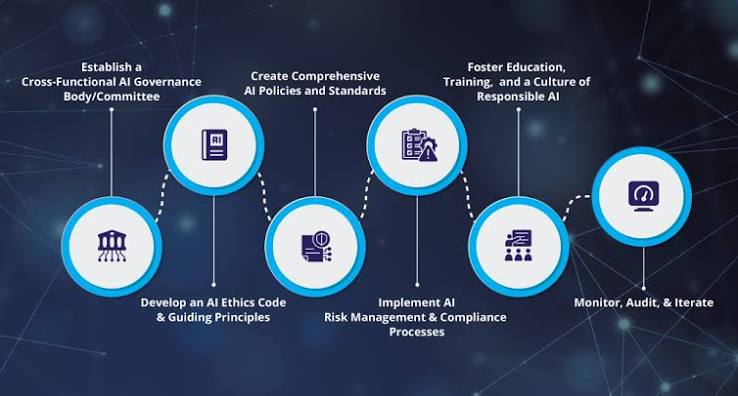
The demand for AI ethics and governance professionals is surging, driven by new regulations like the EU AI Act and corporate risk management. But the field is still young, and most practitioners have reskilled from other disciplines rather than holding formal degrees in AI ethics. This guide breaks down the concrete pathways, skills, and job roles for making the transition.
What Exactly Is AI Ethics and AI Governance?
Think of AI ethics as the moral compass — the principles that say an AI system should be fair, transparent, and accountable. AI governance is the map and the rules that put those principles into practice: the policies, audits, and compliance processes that ensure AI systems actually meet those standards. This field sits at the intersection of computer science, law, philosophy, public policy, and business.
Why the Job Market Is Growing Now
Three forces are pushing organizations to hire AI governance professionals. First, regulation: the EU AI Act, passed in 2024, imposes obligations on developers and deployers based on risk level, with phased implementation through 2026–2027. In the US, while the 2023 Executive Order was partially rescinded in 2025, many state and sectoral laws remain, like NYC’s Local Law 144 on hiring AI. Second, corporate risk: companies face reputational damage, legal liability, and investor pressure (ESG frameworks now often include AI). Third, public trust: biased hiring tools, deepfakes, and generative AI hallucinations have made consumers wary — organizations want to avoid backlash.
The Hybrid Competence Gap
Employers struggle to hire because the field requires a rare combination: understanding both the technical mechanics of AI and the legal/policy landscape. Most current practitioners have reskilled from adjacent fields rather than taking dedicated degree programs, which are still scarce. That’s good news for you — if you have a background in law, engineering, social science, or even communications, you can build the missing piece.
Pathway 1: From Law or Compliance
If you’re a lawyer or compliance officer, you already understand regulatory frameworks and risk assessment. The key is to learn how AI works at a functional level — not to code, but to understand what algorithms do, what data they use, and where bias can creep in. Start by studying the EU AI Act’s risk categories, the OECD AI Principles, and ISO/IEC 42001 (the first international AI management standard).
Typical roles: AI Policy Analyst, AI Compliance Officer, Regulatory Affairs Manager.
Skills to acquire: AI fundamentals, regulatory mapping, impact assessment, stakeholder engagement.
Pathway 2: From Computer Science or ML
If you’re an engineer, you already have the technical chops. The gap is on the ethics and governance side. You need to learn fairness metrics (demographic parity, equalized odds), explainability tools (SHAP, LIME), and adversarial testing methods. This pathway leads to roles like Algorithmic Auditor or Responsible ML Engineer.
Pros: high demand, high pay, less competition from non-technical candidates.
Cons: requires significant upskilling in non-technical areas; risk of being pigeonholed as “just a tester.”
Pathway 3: From Philosophy, Social Science, or Policy
Your strength is critical thinking, ethics, and understanding societal impact. The challenge is gaining technical literacy. You don’t need to build models, but you should be able to read a model card and understand bias reports. Seek out practical courses on AI fundamentals, and consider volunteering for AI audit projects to get hands-on experience.
Typical roles: AI Ethics Researcher, Policy Advisor, Think Tank Analyst.
Pathway 4: From Product or Project Management
If you’ve managed AI products, you know the lifecycle and stakeholder dynamics. Pivot to governance by focusing on risk management, model documentation, and cross-functional coordination. Roles like Responsible AI Manager or AI Risk Assessor fit well.
What Should You Actually Learn?
Start with the regulatory texts: the EU AI Act, OECD AI Principles, and UNESCO’s Recommendation on the Ethics of AI. Then, get a working understanding of how AI systems are built — take a free online course like Elements of AI. Learn to run a basic bias assessment using tools like SHAP or LIME, and understand the concept of an algorithmic impact assessment. Finally, build a portfolio: document your analyses, write case studies, or contribute to open-source AI ethics projects.
Salary Expectations
Entry-level AI policy/ethics analysts earn around $70k–$100k. Mid-level Responsible AI Managers make $120k–$170k. Senior Directors of AI Governance can exceed $250k. Compensation varies by geography, sector (Big Tech vs. nonprofit vs. government), and whether the role is technical or policy-oriented.
The Road Ahead
The field is still defining itself — there’s no single certification or professional body. That’s an opportunity: you can shape your own path. Start with one of the pathways above, build your hybrid skills, and position yourself at the crossroads of technology and responsibility.
Reskilling into AI ethics isn’t about starting over — it’s about building on what you already know. The field needs lawyers who understand algorithms, engineers who understand fairness, and philosophers who understand data. Pick a pathway, close the skills gap, and you’ll be ready for a career that’s both in demand and deeply meaningful.
Summary
- AI ethics and governance is a rapidly growing field, driven by regulation, corporate risk, and public trust.
- Most practitioners reskilled from law, engineering, social science, or product management.
- Key pathways include the technical route (auditing, bias detection) and the policy/legal route (compliance, regulatory roles).
- Hybrid competence — understanding both tech and policy — is the most sought-after skill.
- Salaries range from $70k entry-level to $250k+ for senior roles.
FAQ
Q: Do I need a degree in AI ethics to get a job?
A: No, very few dedicated degree programs exist, and most practitioners reskilled from other fields. Employers value hybrid competence and practical experience.
Q: What is the most common career change path?
A: Two common paths: lawyers and compliance officers moving into policy roles, and software engineers moving into responsible ML or model auditing.
Q: Is AI governance a technical job?
A: It depends on the role. Algorithmic auditors need deep technical skills, while policy analysts focus on regulation and risk. Many roles require a mix.
Q: How long does it take to reskill?
A: Expect 6–12 months of part-time study and portfolio building, depending on your starting point.
Q: Are there certifications I should pursue?
A: Not standardized yet. Focus on learning the regulatory frameworks (EU AI Act, OECD principles) and building practical skills like bias assessment.