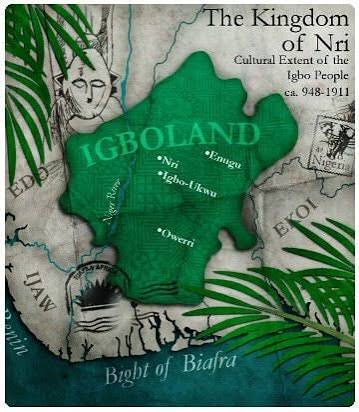
In the dense forests of southeastern Nigeria, a kingdom once held sway over millions not through conquering armies or tax collectors, but through ritual power and the fear of divine wrath. The Kingdom of Nri, founded around the 9th century CE, was a theocratic state that shaped Igbo civilization for nearly a millennium, yet today it remains largely absent from mainstream histories of West Africa.
Nri was a paradox: a state without borders, an empire without soldiers. Its kings were believed to be living gods, and its influence radiated outward through sacred ceremonies, title-taking rituals, and a network of oracles that served as supreme courts across the Igbo hinterland. The story of Nri challenges the conventional narrative that pre-colonial African power was built on military might and territorial expansion.
A Kingdom Built on Belief, Not Battles
Nri’s authority was sacerdotal derived from religious office rather than force. At its heart was the Eze Nri, a spiritual sovereign who was considered a direct descendant of Eri, the mythical sky-being who founded Igbo civilization. The Eze Nri did not command armies or collect taxes; instead, he wielded the ofo (a sacred staff of authority) and the power to “make the land” ritually cleansing communities of abominations and restoring cosmic order.
This model of rule was so effective that it shaped the political culture of the entire Igbo region, which otherwise favored decentralized village republics. In a landscape of autonomous communities governed by councils of elders and age grades, Nri provided a unifying moral framework without political subjugation. Communities voluntarily sought Nri’s blessings, recognizing its spiritual supremacy in exchange for ritual purity and access to sanctified trade routes.
The Mechanics of Spiritual Power
The Nri sphere of influence was maintained through a combination of ritual colonization and economic integration. Priests and titled men traveled across Igboland, performing purification ceremonies, installing Ozo titleholders, and establishing sacred groves. The Ozo title system—originating in Nri—became the region’s premier marker of honor and authority, binding initiates to strict taboos, including the prohibition on shedding blood.
Central to Nri’s judicial power was the Agbala oracle, a supreme court that settled disputes ranging from land conflicts to accusations of witchcraft. Its pronouncements were considered final, backed by the belief that defiance would bring supernatural retribution. Every four years, the Igu Aro festival drew representatives from across the Igbo diaspora to Nri, reaffirming their allegiance, seeking blessings, and having markets ritually sanctified.
The “Nri taboo” reinforced this spiritual authority: within the kingdom’s homeland, bloodshed—human or animal—was forbidden. This prohibition elevated Nri as a zone of peace, where refugees could find sanctuary and where conflict could be mediated without violence.
Material Riches and Trade Networks
Despite its non-military character, Nri was no backwater. The famous Igbo-Ukwu bronzes, discovered in 1938 and dated to the 9th–10th century, are among the earliest and most sophisticated lost-wax castings in West Africa. Their intricate designs—featuring insects, animals, and human figures—reveal a society with advanced metallurgical skills and deep ritual symbolism. Scholars widely believe these artifacts are linked to the Nri cultural sphere, though the exact relationship remains debated.
The site also yielded glass beads from the Middle East and copper that likely originated from Saharan or European sources, evidence of Nri’s participation in trans-Saharan and later Atlantic trade networks. Nri’s ritual authority facilitated commerce: by sanctifying markets and trade routes, it enabled the movement of ivory, cloth, and metals under religiously guaranteed peace.
The Colonial Cataclysm
Nri’s influence waned in the 18th and 19th centuries due to internal changes and the upheavals of the Atlantic slave trade, which eroded its moral authority. But the final blow came with British colonialism. In 1911, the British formally abolished the institution of the Eze Nri, dismantling a spiritual empire that had endured for a millennium. The last recognized king, Eze Nri Òbalíke, was exiled, and the ritual infrastructure was suppressed.
The colonial authorities, accustomed to ruling through military force and administrative hierarchies, saw little value in a king who ruled by spiritual mandate. They failed to understand that Nri’s power was not a weakness but a sophisticated alternative to coercive governance—one that had maintained peace and facilitated trade across a vast region for centuries.
Why Nri Matters Today
Nri’s story challenges simplistic narratives of African statecraft. It demonstrates that political power can be rooted in religious authority, not just military might. The kingdom’s legacy persists in the Ozo title system, still practiced across Igboland, and in the cultural memory of the Igbo people. Yet, in many world history textbooks, Nri is invisible—a casualty of a colonial lens that equated power with conquest.
Rediscovering Nri is not just an academic exercise. It offers a powerful counterexample to the notion that centralized states require coercion. In an era when questions of legitimacy and governance are hotly debated, the forgotten kingdom of Nri presents a historical model where authority was earned through ritual service, moral example, and the promise of cosmic protection—a model that ruled minds without raising swords.
The Kingdom of Nri was not an anomaly but a flourishing alternative—a theocratic state that shaped Igbo civilization for centuries without ever raising an army. Its story was suppressed by colonial rule, but its legacy endures in the rituals, titles, and moral codes that still resonate across southeastern Nigeria. By remembering Nri, we restore a vital piece of West African history and expand our understanding of how power can be exercised—not through force, but through faith.
Summary
- Nri was a theocratic Igbo state (9th–19th century CE) that exercised spiritual authority over decentralized communities across southeastern Nigeria.
- The Eze Nri, considered a living deity, ruled through ritual power, the ofo staff, and the ability to sanctify the land—not through armies or taxation.
- Nri’s influence spread through the Ozo title system, the Agbala oracle, and the Igu Aro festival, unifying communities without political subjugation.
- The kingdom was linked to the sophisticated Igbo-Ukwu bronzes and participated in trans-Saharan and Atlantic trade networks.
- British colonial authorities abolished the Nri kingship in 1911, but its cultural legacy persists in Igbo society today.
FAQ
Q: What was the Kingdom of Nri?
A: Nri was a theocratic, sacerdotal state in the northwestern Igbo region of present-day southeastern Nigeria. It was a spiritual center whose authority derived from religious legitimacy rather than military conquest, and it influenced Igbo society from roughly the 9th to the 19th century CE.
Q: How did Nri maintain power without an army?
A: Nri’s power was based on the belief that the Eze Nri was a divine descendant of Eri. The king controlled fertility, rainfall, and moral order. Priests performed “ritual colonization,” cleansing communities and installing titleholders. The Nri taboo forbade bloodshed in the homeland, reinforcing their role as peacemakers.
Q: What was the Ozo title system?
A: It was a set of title-taking rituals originating in Nri that conferred honor and political authority. Men who took these titles were bound by strict taboos, including no shedding of blood. The system spread across Igbo society and remains practiced today.
Q: What is the connection between Nri and the Igbo-Ukwu bronzes?
A: The Igbo-Ukwu bronzes, dated to the 9th–10th century, are believed by scholars to be linked to the Nri cultural and ritual sphere, though the exact relationship is debated. They demonstrate advanced lost-wax casting and long-distance trade connections.
Q: Why is Nri called “forgotten”?
A: Nri was formally abolished by British colonial authorities in 1911, and its history was overshadowed by narratives that emphasized military empires. Colonial administrators did not recognize spiritual authority as legitimate governance, leading to its omission from many historical accounts.