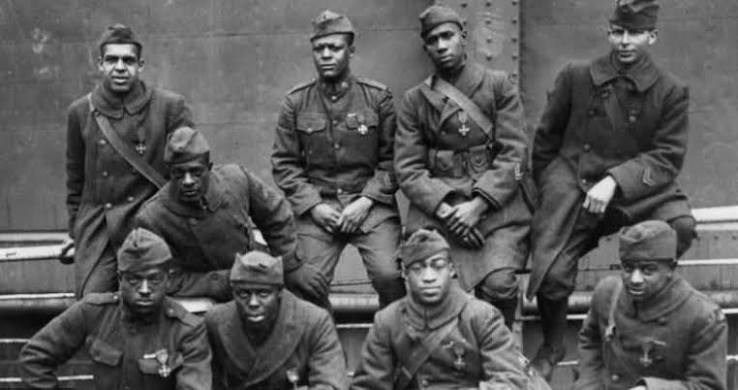
In the early hours of May 15, 1918, in the Argonne forest of France, two Black American soldiers found themselves surrounded by a German raiding party of nearly twenty men. One of them, Henry Johnson, had run out of ammunition. He used his rifle as a club, then pulled out a bolo knife and attacked. By dawn, the raiders had retreated, leaving Johnson and his partner Needham Roberts wounded but victorious. That night, they became the first Americans of any race to receive France’s highest military honor, the Croix de Guerre with Palm.
These men were part of the 369th Infantry Regiment, nicknamed the ‘Harlem Hellfighters’ by the Germans they fought against. The unit spent 191 days on the front lines—longer than any other American regiment in World War I—and never lost a foot of ground or a man to capture. Yet when they returned home, they were met not with parades but with the same segregation and violence they had left behind. This is their story, and it’s a story that corrects a common misconception: the Hellfighters were a World War I unit, not a World War II one.
The Making of the Hellfighters
When the United States entered World War I in 1917, the military was strictly segregated. African Americans were largely relegated to labor, supply, and stevedore roles, not combat. But the 369th Infantry Regiment—originally the 15th New York National Guard—was different. It was one of the few Black combat regiments, and its soldiers were determined to fight.
Colonel William Hayward, the regiment’s commanding officer, pushed for his men to see action. But the U.S. Army, reflecting the racism of the era, was reluctant to use Black soldiers in battle. So in 1918, the 369th was ‘loaned’ to the French Army, which was desperate for reinforcements. The French were more egalitarian in their treatment of Black soldiers, and they equipped, fed, and integrated the regiment into their units. The Hellfighters wore French helmets, carried French rifles, and fought under French command.
The nickname ‘Hellfighters’ reportedly came from the Germans, who called them Höllenkämpfer—hellfighters—for their ferocity. The French had their own name: Hommes de Bronze, or ‘Men of Bronze.’
191 Days on the Front
From their deployment in 1918, the 369th spent 191 days on the front lines—more than any other American unit in the war. They fought in some of the bloodiest battles of the final year, including the Second Battle of the Marne and the Meuse-Argonne Offensive, where they played a critical role in halting the German Spring Offensive.
The toll was staggering. The regiment suffered approximately 1,500 casualties—killed, wounded, or missing—out of a fighting strength of about 3,000 men. That’s a casualty rate of roughly 50%, the highest of any American regiment. Yet they never lost a man to capture, and they never gave up ground they held.
One of the most famous actions came on May 15, 1918, when Henry Johnson and Needham Roberts were on sentry duty. A German raiding party of at least a dozen men attacked. Both Americans were wounded, and Johnson ran out of ammunition. He clubbed and knifed the attackers, driving them off. The action earned both men the Croix de Guerre with Palm, the highest grade of the award—the first time Americans had received it. Johnson was also posthumously awarded the U.S. Medal of Honor in 2015, more than 95 years after his death.
The entire regiment received the French Croix de Guerre with Silver Star, and 171 individual members earned the Croix de Guerre. No other American unit in World War I was so decorated.
The Band That Brought Jazz to Europe
The Hellfighters weren’t just soldiers—they were cultural ambassadors. The regimental band, led by Lieutenant James Reese Europe, was a sensation in France. Europe, already a famous jazz bandleader in New York, brought his syncopated rhythms to European audiences, performing for troops and civilians alike. The band is widely credited with introducing jazz to France and sparking the Jazz Age in Europe. For many French people, the Hellfighters’ music was their first taste of a uniquely American art form.
A Bitter Homecoming
The Hellfighters returned to the United States as heroes—but they were not treated like heroes. The country was still deeply segregated, and the soldiers who had fought for democracy abroad were denied it at home. In the summer of 1919, a wave of racial violence known as the Red Summer swept the nation. Some Hellfighters were attacked for wearing their uniforms, a stark reminder that the fight for equality was far from over.
The regiment’s legacy is a complex one: they were celebrated in France, decorated by a foreign government, and yet still faced the same systemic racism in America. Their story is a testament to their courage and a reminder of the long struggle for civil rights.
The Harlem Hellfighters were not just the most decorated American unit of World War I—they were a symbol of what Black soldiers could achieve when given the chance. Their 191 days on the front, their unprecedented decorations, and their cultural impact in France all speak to their extraordinary service. And yet, their homecoming was a bitter reminder of the deep racial divides in America. Their story is one of valor and injustice, of triumph and tragedy. And it’s a story that deserves to be remembered, not for what it wasn’t—a WWII unit—but for what it truly was: a groundbreaking chapter in American military history.
Summary
- The Harlem Hellfighters were a World War I unit, not a WWII unit, despite a common misconception.
- The 369th Infantry Regiment spent 191 days on the front lines, the longest of any American unit in WWI, and suffered a 50% casualty rate.
- The entire regiment received the French Croix de Guerre, and 171 individuals were also decorated.
- Henry Johnson and Needham Roberts were the first Americans to receive the Croix de Guerre with Palm.
- James Reese Europe’s band introduced jazz to France, making the regiment cultural ambassadors as well as soldiers.
FAQ
Q: Were the Harlem Hellfighters a WWII unit?
A: No. The Harlem Hellfighters were a World War I unit, active from 1917 to 1918. They did not serve in World War II.
Q: Why were they called the Harlem Hellfighters?
A: The nickname was given by German soldiers, who reportedly called them ‘Höllenkämpfer’ (Hellfighters) due to their ferocity in combat. The French called them ‘Men of Bronze.’
Q: What was the 369th Infantry Regiment’s combat record?
A: They spent 191 days on the front lines, longer than any other American unit in WWI. They had about 1,500 casualties (50% of their strength), but never lost a man to capture or gave up ground.
Q: What decorations did the Hellfighters receive?
A: The entire regiment received the French Croix de Guerre with Silver Star. 171 individuals received the Croix de Guerre. Henry Johnson and Needham Roberts were the first Americans to receive the Croix de Guerre with Palm. Johnson also received the U.S. Medal of Honor posthumously in 2015.
Q: How did James Reese Europe contribute to the regiment’s legacy?
A: James Reese Europe led the regimental band and is credited with introducing jazz to France and Europe, helping spark the Jazz Age.