Imagine standing on a dock, watching a sailboat glide directly toward the direction from which the wind is blowing. The sails are full, the boat cuts through the water, and it seems to defy common sense. After all, wind pushes things so how can it push a boat into its own source?
The answer lies in a elegant piece of physics that involves wings, water, and a subtle shift in perspective. Sailing upwind isn’t a magic trick; it’s a masterclass in fluid dynamics, Newton’s laws, and the clever design of boats. In this article, we’ll break down the mechanics in plain terms, revealing how a boat turns the wind’s force into forward motion even when that wind seems to be opposing it.
The Wind’s Push Isn’t the Whole Story
When you blow on a paper boat in a puddle, it moves away from you. That’s the intuitive picture of sailing: the wind pushes the sails, and the boat goes downwind. But that’s only half the story—the simpler half. Upwind sailing works differently, relying on a phenomenon more akin to how an airplane wing generates lift than how a fan pushes air.
To understand this, we need to look at the shape of a sail. A well-trimmed sail isn’t flat like a bedsheet; it’s curved like a wing. When wind flows over this curved surface, it speeds up on the leeward (downwind) side and slows down on the windward side. According to Bernoulli’s principle, faster-moving air creates lower pressure. This pressure difference creates a force that pulls the sail sideways, perpendicular to the wind’s direction. This is lift—the same force that keeps airplanes in the sky, but here it acts horizontally.
The Sail as a Vertical Wing
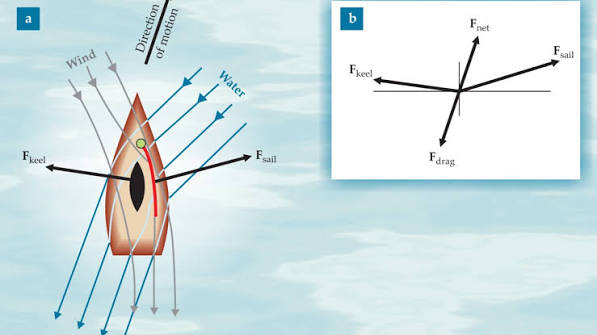
Think of a sail as an airplane wing turned on its side. An airplane wing generates lift upward, counteracting gravity. A sail generates lift sideways, but the boat’s hull and keel prevent it from moving too far in that direction. Instead, the lift is channeled into forward motion.
Here’s the key: when a boat is angled to the wind—say, 45 degrees off—the lift force isn’t purely sideways. It has a component pointing forward along the boat’s heading. That forward component is what drives the boat. The sideways component, which would push the boat over, is counteracted by the keel, a fin that extends down into the water. The keel acts like a second wing, but in water: it generates hydrodynamic lift to resist sideways motion, allowing the boat to convert the sail’s force into forward progress.
Apparent Wind: The Wind You Feel Isn’t the Real Wind
Here’s a subtlety that often confuses newcomers: when you’re on a moving boat, the wind you feel isn’t the same as the wind blowing over the water. It’s a combination of the true wind and the wind created by your own motion. This is called apparent wind, and it’s crucial for upwind sailing.
Imagine riding a bicycle on a calm day. Even with no real wind, you feel a breeze in your face because of your forward motion. Now, if there’s a real wind blowing from the north and you ride north, the apparent wind is stronger—it’s the sum of your speed and the true wind. If you ride south, the apparent wind is weaker—the true wind and your motion cancel out.
For a sailboat, the apparent wind shifts forward as the boat speeds up. This means the sail can be trimmed more efficiently, and the lift force is directed more forward. In fact, this effect allows iceboats and land yachts to sail faster than the true wind speed, sometimes several times faster. They have very low drag, so they can accelerate until the apparent wind is coming almost directly from ahead, and the sail acts like a wing generating lift to push them forward.
Tacking: The Zigzag to Windward
No boat can sail directly into the wind. There’s always a ‘no-go zone’ of about 30 to 45 degrees on either side of the wind direction. Within that zone, the sails can’t generate enough lift to overcome drag, and the boat would stall. Instead, sailors use a technique called tacking.
Tacking is like a sailboat’s version of zigzagging. The boat sails at an angle to the wind—say, 45 degrees off—for a while, then turns through the wind (with the bow pointing into the wind) and sails at the same angle on the other side. By alternating tacks, the boat makes forward progress upwind, even though it’s never heading directly into the wind.
The maneuver requires careful timing and sail handling, but it’s a fundamental skill that has been used for centuries. Ancient ships with square sails couldn’t do this; they were limited to downwind sailing. The development of lateen sails and fore-and-aft rigs allowed boats to tack, opening up the oceans for exploration and trade.
The Physics in Numbers
Modern sailboats can sail upwind at about 30 to 45 degrees off the true wind. Iceboats, with their lack of water resistance, can get as close as 10 to 15 degrees. And America’s Cup foiling catamarans—which lift out of the water on hydrofoils—can achieve speeds several times the wind speed, thanks to their ability to generate enormous lift with minimal drag.
The theoretical maximum speed of a sailboat depends on the balance between the lift generated by the sails and the drag of the hull. The lower the drag, the faster the boat can go. That’s why foiling boats, which reduce drag by lifting out of the water, are so fast.
Why It Feels Like Magic
To the casual observer, a boat sailing upwind seems to violate common sense. We’re used to wind pushing things along, not against. But once you understand the role of lift, apparent wind, and the keel, it becomes clear: the boat is not being pushed by the wind; it’s being pulled by the pressure difference across the sail, and the keel keeps it from sliding sideways.
This same physics underlies many technologies: wind turbines use airfoil-shaped blades to generate lift and spin a rotor; airplane wings use lift to overcome gravity; and kiteboarders use the same principles to sail upwind. So next time you see a sailboat tacking upwind, you’ll know it’s not defying physics—it’s mastering it.
Sailing against the wind isn’t a paradox once you understand the forces at play. The wind’s energy is converted into forward motion through aerodynamic lift, the keel’s hydrodynamic resistance, and the clever use of apparent wind. It’s a beautiful example of how human ingenuity has harnessed natural forces to do something that seems impossible—moving toward the very source of the push.
Summary
- Sailboats can sail upwind by tacking at 30–45 degrees to the wind; they can’t sail directly into it.
- The sail acts like a vertical wing, generating lift perpendicular to the apparent wind.
- The keel acts as a second wing in water, preventing sideways drift and turning lift into forward motion.
- Apparent wind—the wind felt on a moving boat—is key; it shifts forward as speed increases, improving efficiency.
- Iceboats and foiling boats can exceed wind speed due to low drag and optimized sail design.
FAQ
Q: Can a sailboat sail directly into the wind?nA: No, there’s always a ‘no-go zone’ of about 30–45 degrees around the wind direction. Sailboats must zigzag (tack) to make upwind progress.nnQ: Why does a sailboat use a keel?nA: The keel generates hydrodynamic lift to resist the sideways force of the wind, preventing the boat from sliding sideways and converting the sail’s force into forward motion.nnQ: What is apparent wind?nA: Apparent wind is the wind you feel on a moving boat—the vector sum of the true wind and the wind caused by your own motion. It’s crucial for trimming sails effectively.nnQ: How fast can a sailboat go compared to the wind?nA: Some boats, like iceboats and foiling catamarans, can go several times faster than the true wind speed, thanks to low drag and the aerodynamic lift of their sails.nnQ: Is sailing upwind similar to how airplanes fly?nA: Yes, sails generate lift like airplane wings, using pressure differences created by airflow over curved surfaces. The keel counteracts sideways motion, similar to how an airplane’s rudder and fuselage provide stability.