In the summer of 1918, the German army made one final, desperate gamble to win World War I before American troops could tip the balance. The Second Battle of the Marne, fought from July 15 to July 18, 1918, was the last German offensive of the war—and it failed catastrophically. This article unpacks the battle’s strategy, the turning point it represented, and why it set the stage for the Armistice just four months later.
The battle was not just another clash on the Western Front. It was a high-stakes race against time. Germany had knocked Russia out of the war and transferred hundreds of thousands of troops west, hoping to achieve a decisive victory before the United States could deploy its millions of fresh soldiers. The Marne was where that gamble collapsed, and the Allied counteroffensive that followed marked the beginning of the Hundred Days Offensive that ended the war.
The Strategic Setting: A Salient Pointing at Paris
By early 1918, Germany’s strategic position was dire. The British naval blockade was strangling its economy, and the entry of the United States into the war in 1917 threatened to tip the manpower balance decisively against the Central Powers. General Erich Ludendorff, the de facto German commander, launched a series of massive offensives in the spring of 1918—Operation Michael, Georgette, Blücher-Yorck, and others—designed to crush the Allies before American divisions arrived in force.
These Spring Offensives drove deep into Allied territory, creating a large bulge in the front line along the Marne River, only about 60 miles from Paris. This salient was a tempting target for the Allies, but for Ludendorff it was a launching pad. His plan, Operation Marneschutz-Reims, called for a two-pronged assault: one army would cross the Marne east of Reims, another west of Reims, to encircle the city and split the French lines. If successful, the Germans would capture Reims, roll up the French defenses, and potentially force a negotiated peace before the Americans could matter.
But Ludendorff was overreaching. His troops were exhausted after months of offensive operations, supply lines were stretched thin, and he had no significant reserves to exploit a breakthrough. The plan was a gamble that relied on speed and surprise—and surprise was the one thing he didn’t have.
The Allied Intelligence Advantage
The French had broken German radio codes and knew the timing and location of the attack in advance. General Henri Gouraud, commanding the French Fourth Army east of Reims, used this intelligence to devastating effect. He deliberately evacuated his frontline trenches, leaving only light screening forces to absorb the initial German barrage. Meanwhile, he concentrated his artillery on the rear areas where German troops would mass.
When the German artillery opened fire on July 15, it was largely wasted on empty trenches. Then, as German infantry advanced, they walked into a killing zone of French artillery and machine-gun fire. The attack east of Reims stalled almost immediately.
West of Reims, the Germans initially had more success. They crossed the Marne River and pushed forward several miles, but they were soon slowed by determined resistance, particularly from the American 3rd Division. This division, which had only recently arrived in France, held its ground at the Marne crossings, earning the nickname “Rock of the Marne.” At the bridge at Mézy, American troops counterattacked and threw the Germans back across the river.
The Great Counteroffensive: July 18, 1918
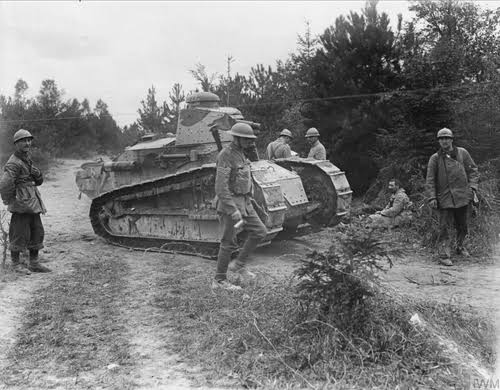
With the German attack stalling, Supreme Allied Commander Ferdinand Foch saw his opportunity. On July 18, he launched a massive counteroffensive against the western flank of the Marne salient, near Soissons. The attack featured about 350 tanks—mostly French Renault FTs—and a combined force of French and American infantry, including the U.S. 1st and 2nd Divisions.
The assault caught the Germans completely off guard. They had been focused on their own offensive and had not expected the Allies to launch a major attack so quickly. The use of tanks, which were still a relatively new weapon, allowed the Allies to break through German lines despite minimal artillery preparation. The French and Americans advanced up to five miles on the first day, threatening to cut off the German forces inside the salient.
Faced with the prospect of encirclement, Ludendorff ordered a retreat. Over the following weeks, the Allies pushed the Germans back to the Aisne and Vesle rivers, erasing the Marne salient entirely by early August. The battle was over, and the strategic initiative had passed permanently to the Allies.
Why the Battle Was a Turning Point
The Second Battle of the Marne was decisive for several reasons. First, it marked the end of German offensive capability on the Western Front. The German army had suffered approximately 139,000 casualties during the battle—killed, wounded, or captured—and had lost irreplaceable equipment and experienced soldiers. Ludendorff’s dream of winning the war before the Americans arrived was shattered.
Second, it demonstrated the effectiveness of combined-arms tactics. The Allied counteroffensive integrated infantry, artillery, tanks, and air power in a coordinated assault, a precursor to the more sophisticated operations of the Hundred Days Offensive. The success also validated Foch’s strategy of maintaining a strong central reserve and using it to strike at the enemy’s weakest point.
Third, the battle had profound psychological effects. For the French, it was a vindication after the devastating mutinies of 1917 and the German advances of early 1918. The defense of Paris was a national triumph. For the Americans, it proved that their troops could fight and win against the best of the German army. For the Germans, the defeat was a demoralizing blow; many soldiers began to see the war as unwinnable, and desertions increased in the months that followed.
The Human Cost
Casualty figures are grim. Allied losses were approximately 95,000 French, 16,000 British, and 12,000–15,000 American soldiers. German losses were higher, around 139,000. For many American soldiers, this was their first major battle, and they showed remarkable bravery and effectiveness. The 3rd Division’s stand at the Marne became a legend, but it came at a price: the division suffered over 1,900 casualties in three days of fighting.
German soldiers faced a different kind of suffering. Many were underfed, exhausted, and increasingly disillusioned. The arrival of fresh American troops, who seemed to have endless supplies and high morale, further undermined their confidence. The Second Marne was not just a military defeat; it was a psychological blow from which the German army never recovered.
The Road to the Armistice
The Allied counteroffensive at the Marne did not end the war overnight, but it set the stage. In August 1918, the Allies launched the Hundred Days Offensive, a series of coordinated attacks that pushed the Germans back relentlessly. With its army collapsing and its allies surrendering, Germany sued for peace, and the Armistice was signed on November 11, 1918.
The Second Battle of the Marne is often overshadowed by other events of the war, but it deserves recognition as one of the most important battles of the conflict. It was the turning point where the Allies seized the initiative and never let go. For the Germans, it was the last great offensive, and its failure sealed the fate of the Kaiserreich.
The Second Battle of the Marne was more than just a military engagement; it was the decisive moment when the tide of World War I turned irrevocably. The failure of the German offensive and the success of the Allied counteroffensive demonstrated that the Central Powers could no longer win the war. It was a battle of intelligence, courage, and strategic vision, and it paved the way for the final Allied victory. Understanding this battle helps us appreciate the complexity of the Great War and the fragility of empires that dared to overreach.
Summary
- Dates and Outcome: The Second Battle of the Marne (July 15–18, 1918) was the last German offensive of WWI, ending in a decisive Allied victory.
- German Plan: Operation Marneschutz-Reims aimed to encircle Reims and split French lines, but the Allies knew the plan in advance thanks to broken codes.
- Allied Counteroffensive: On July 18, Foch launched a tank-led attack that collapsed the Marne salient, forcing the Germans to retreat.
- Casualties: German losses were ~139,000; Allied losses were ~95,000 French, 16,000 British, and 12,000–15,000 American.
- Significance: The battle ended German offensive capability, boosted Allied morale, and set the stage for the Hundred Days Offensive and the Armistice in November 1918.
FAQ
Q: Why was the Second Battle of the Marne important?
A: It was the last major German offensive of World War I. Its failure marked the turning point of the war, as the Allies seized the initiative and launched the Hundred Days Offensive that led to the Armistice.
Q: What was the “Rock of the Marne”?
A: It was the nickname given to the U.S. 3rd Division for its determined defense of the Marne River crossings on July 15, 1918, where it held its ground against German attacks.
Q: How did the Allies know about the German attack?
A: The French had broken German radio codes and knew the timing and location of the offensive. This allowed them to prepare a devastating defense, including evacuating frontline trenches and concentrating artillery.
Q: What role did tanks play in the battle?
A: The Allied counteroffensive on July 18 used about 350 tanks, mostly French Renault FTs. Their surprise appearance helped break through German lines and was crucial to the success of the attack.
Q: How many American troops fought in the Second Battle of the Marne?
A: Approximately 85,000–110,000 American troops participated, including the 3rd, 1st, and 2nd Divisions, among others. Their performance demonstrated that American soldiers could fight effectively against the German army.