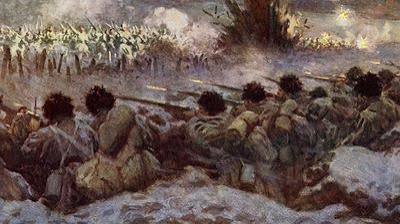
The winter of 1916 found the Western Front locked in a stalemate of mud and wire. Two battles, launched within five months of each other, would come to define the brutality of the First World War. At Verdun, the German army sought to bleed France white. On the Somme, the British and French aimed to break the German line. Both failed in their strategic goals, but together they consumed over a million casualties in a single year. Which was more devastating? The answer depends on how you measure devastation—by raw numbers, by daily toll, or by the lasting scar on the nations that fought.
The Two Battles: A Study in Contrasts
Verdun and the Somme were not just different battles; they were different kinds of war. Verdun, which raged from February 21 to December 18, 1916, was a compact, grinding siege fought over a 20-kilometer front along the Meuse River. The German chief of staff, Erich von Falkenhayn, planned it as an attritional masterstroke: attack a fortress the French could not abandon, forcing them to pour troops into a meat grinder until their army collapsed. The Somme, from July 1 to November 18, was a broader Allied offensive on a 30-kilometer front, originally conceived as a French-led breakthrough but transformed into a British-led relief effort after Verdun bled the French army dry.
These differences shaped the experience of the soldiers. At Verdun, the French rotated roughly 70% of their army through the battle, earning it the nickname ‘the mill on the Meuse.’ The entire battle was fought over a few square miles of shell-pocked hills and forts, with the crucial supply road—the Voie Sacrée—kept open by a relentless convoy of trucks. On the Somme, the British launched set-piece attacks after massive preliminary bombardments, and on September 15, they introduced the tank at Flers-Courcelette, a weapon that was too few in number and too unreliable to change the outcome.
The Arithmetic of Death: Total Casualties
The most obvious measure of devastation is the raw count of casualties. For Verdun, the widely cited figures are 377,000 French and 337,000 German casualties, totaling about 714,000. Some estimates push the combined toll to a million. For the Somme, the numbers are higher: approximately 420,000 British Empire casualties, 200,000 French, and between 450,000 and 500,000 German, for a total of over 1.1 million. By this metric, the Somme was clearly more devastating in aggregate—roughly 400,000 more casualties than Verdun.
But raw totals obscure the intensity of suffering. The Somme’s first day alone, July 1, 1916, remains the bloodiest day in British military history: nearly 57,000 British casualties, including about 19,000 dead, most within the first few hours. No single day at Verdun came close to that. Yet Verdun’s 302 days of continuous combat meant that the front was a charnel house for nearly a year, with no respite.
Daily Toll: The Grinding Horror
When you divide casualties by days of fighting, a different picture emerges. The Somme lasted 141 days and produced roughly 7,000 to 9,200 casualties per day. Verdun, over 302 days, produced roughly 2,300 to 3,300 per day. The Somme’s daily toll was nearly three times higher. This was due to the density of artillery and the nature of the offensive: on the Somme, the Allies launched repeated infantry assaults against prepared German positions, while at Verdun, the fighting was more evenly matched, with both sides launching counterattacks and defending in a relatively confined space.
The Somme was also more costly for the British Empire because of the ‘Pals Battalions’—volunteer units recruited from the same towns and factories. On the first day, entire communities lost their young men in a single morning. The psychological shock in Britain was incalculable, and it reverberated through the rest of the war.
Territorial Change: The Futility of It All
Both battles ended with front lines that were almost identical to where they started. At Verdun, the Germans initially captured the key forts of Douaumont and Vaux, but the French counter-offensive in October and December 1916 recaptured most of the lost ground. By the end, the front had returned to roughly its original position. The only permanent change was the complete destruction of the landscape—villages were erased, forests reduced to splinters, and the earth itself was churned into a lunar landscape.
The Somme saw a slightly larger territorial change: the Allies advanced about 7 miles (11 kilometers) at the deepest point, capturing villages like Thiepval and Flers. But this advance fell far short of the planned breakthrough. In terms of strategic value, both battles were equally futile. The German army was severely strained by both, but it did not collapse. The French army was shaken at Verdun but held. The British army gained experience but at a terrible price.
The Human Cost: Deaths and Lasting Scars
The number of deaths—killed or missing—is another critical measure. At Verdun, the combined deaths were roughly 300,000: 163,000 French and 143,000 German. At the Somme, deaths were between 300,000 and 350,000 combined. The difference is not as stark as total casualties, partly because the Somme’s wounded-to-killed ratio was higher, due to the nature of the artillery bombardments and infantry tactics.
But the devastation goes beyond numbers. Verdun became a symbol of French endurance, embodied in General Philippe Pétain’s order ‘Ils ne passeront pas’—’They shall not pass.’ The battle left a permanent scar on the French psyche, a collective memory of sacrifice that would influence French strategy and politics for decades. The Somme, particularly for Britain and the Commonwealth, became a synonym for the horror of trench warfare and the perceived incompetence of commanders like Douglas Haig. The memory of the Somme shaped British attitudes toward war and remembrance, and its cemeteries and memorials—like the Thiepval Memorial to the Missing—are among the most visited sites on the Western Front.
Conclusion: Which Was More Devastating?
The answer is not simple. If devastation is measured by total casualties, the Somme was worse, with over a million men killed, wounded, or missing. If measured by daily intensity, the Somme again takes the lead, with nearly 8,000 casualties per day. But if measured by duration and the psychological toll on a single nation, Verdun’s 302 days of relentless attrition on the French army may be more devastating. The Somme was a broader catastrophe, affecting the British, French, and German armies. Verdun was a focused horror that nearly broke the French will to fight. In the end, both battles were part of the same tragedy: the Western Front’s descent into industrialized slaughter, where the only goal was to kill more of the enemy than he could kill of you. Neither battle achieved its strategic objective, and both left a generation in ruins. The true measure of devastation lies not in the numbers, but in the fact that the war continued for two more years after these battles, and the dead were replaced by fresh conscripts who would face the same futility.
Verdun and the Somme were twin pillars of the 1916 bloodbath, each devastating in its own way. The Somme’s higher casualty figures and daily toll make it numerically worse, but Verdun’s year-long grind and its near-fatal impact on the French army make it a unique symbol of national sacrifice. Neither battle changed the course of the war; they only deepened the tragedy. As we remember the dead, the question of which was more devastating becomes less important than the shared lesson: the human cost of war is always too high, and the promises of decisive victories are too often lies.
Summary
- The Battle of the Somme produced more total casualties (over 1.1 million) compared to Verdun (about 714,000).
- The Somme had a much higher daily casualty rate, around 7,000–9,200 per day versus Verdun’s 2,300–3,300.
- Both battles ended with minimal territorial changes, but the Somme saw a deeper Allied advance of about 7 miles.
- Verdun was the longest battle of World War I, lasting 302 days, and nearly broke the French army.
- The Somme’s first day was the bloodiest in British military history, with 57,000 casualties, including 19,000 dead.
FAQ
Q: Which battle had higher total casualties?
A: The Battle of the Somme, with over 1.1 million casualties, compared to Verdun’s approximately 714,000.
Q: Why was Verdun so important to France?
A: Verdun was a symbol of French national pride and a fortress city. The German plan was to force France to defend it at all costs, bleeding their army dry, which is why it became a symbol of French endurance.
Q: What was the strategic goal of the Somme?
A: The Somme was a joint Allied offensive to relieve pressure on Verdun and achieve a breakthrough against German lines. It was originally planned as a French-led attack but became primarily a British operation after Verdun diverted French troops.
Q: How did the daily casualty rates compare?
A: The Somme averaged about 7,000–9,200 casualties per day, while Verdun averaged about 2,300–3,300. The Somme was more intense on a daily basis.
Q: Did either battle achieve its objectives?
A: No. Verdun’s German offensive failed to capture the city and the front returned to its start. The Somme’s Allies advanced just 7 miles, far short of a breakthrough, and the German lines held.